Die Vor- und Nachteile: Übersicht über Sportwetten ohne Oasis
In der Welt der Sportwetten gibt es immer wieder neue Angebote und Regelungen. Eine der aktuellen Diskussionen dreht sich um Sportwetten ohne Oasis, ein System, das ursprünglich eingeführt wurde, um problematisches Wettverhalten zu erkennen und zu verhindern. In diesem Artikel werden wir die Vor- und Nachteile dieser Wettarten betrachten und herausfinden, ob sie tatsächlich eine bessere Alternative zu herkömmlichen Sportwetten darstellen.
Was sind Sportwetten ohne Oasis?
Sportwetten ohne Oasis beziehen sich auf Wettplattformen, die nicht an das zentrale Spielersystem Oasis angeschlossen sind. Oasis dient dazu, Informationen über Wettverhalten zu sammeln, um problematische Spieler frühzeitig zu identifizieren. Wettanbieter, die nicht über dieses System arbeiten, können ihren Kunden ermöglichen, anonyme Wetten zu platzieren, ohne dass ihre Daten gespeichert werden.
Die Abwesenheit von Oasis kann sowohl Vorteile als auch Risiken mit sich bringen. Sie appelliert an Kunden, die mehr Privatsphäre wünschen, birgt jedoch auch die Gefahr, dass problematisches Verhalten nicht erkannt wird. Ein Verständnis dieser Dynamik ist entscheidend, bevor man sich für Sportwetten ohne Oasis entscheidet.
Vorteile von Sportwetten ohne Oasis
Die Nutzung von Sportwetten ohne Oasis bietet einige deutliche Vorteile, die für viele Spieler attraktiv sind. Hier sind einige der Hauptvorteile:
Anonymität: Spieler können Wetten platzieren, ohne ihre personenbezogenen Daten angeben zu müssen.
Einfacherer Zugang: Oft sind die Registrierungsprozesse weniger aufwändig, was einen schnelleren Einstieg ermöglicht.
Wettvielfalt: Anbieter ohne Oasis haben oft eine größere Auswahl an Wettmöglichkeiten, da sie flexibler in den angebotenen Optionen sind.
Schnellere Auszahlungen: Einige Anbieter bieten sofortige Auszahlungen, da sie weniger bürokratische Anforderungen haben.
Keine Sperren: Spieler, die gesperrt wurden, können oft weiterhin bei diesen Anbietern Wettvergnügen finden.
Nachteile von Sportwetten ohne Oasis
Trotz der Vorteile gibt es auch signifikante Nachteile, die Spieler beachten sollten. Diese sind potenziell riskant und sollten bei der Entscheidung für solche Angebote berücksichtigt werden: sportwetten ohne oasis
Fehlende Kontrolle: Ohne das Oasis-System gibt es weniger Möglichkeiten zur Überwachung des Wettverhaltens von Spielern, was problematisches Wetten begünstigen kann.
Weniger Verbraucherschutz: Oft haben Spieler weniger Rechte und Schutzmaßnahmen, da diese Anbieter aus verschiedenen Gründen rechtlich weniger reguliert sind.
Risiko von Betrug: Es besteht eine größere Gefahr, auf unseriöse Anbieter zu stoßen, da weniger Kontrollen vorhanden sind.
Hohe Verluste: Spieler könnten durch unkontrolliertes Wetten schneller in finanzielle Schwierigkeiten geraten.
Keine Spieldaten: Spieler haben keinen Zugang zu ihren Wettstatistiken, was die Selbstreflexion und das Management des Wettverhaltens erschwert.
Regulierung von Sportwetten ohne Oasis
Die Regulierung von Sportwetten in Deutschland ist ein komplexes Thema. Während Sportwetten mit Oasis stark überwacht sind, gibt es für Wettanbieter ohne dieses System oft weniger klare Vorschriften. Hierbei sollten folgende Punkte beachtet werden:
Die rechtlichen Rahmenbedingungen könnten unterschiedlich sein, je nach Anbieter und Bundesland.
Wettanbieter müssen eventuell mit schärferer Kritik rechnen, da sie sich nicht an das zentrale System halten.
Die Lizenzierung und Regulierung kann variieren und sollte stets vor der Anmeldung geprüft werden.
Verbraucherschutzmaßnahmen sind oft nicht so stark wie bei regulierten Anbietern.
Fazit
Zusammenfassend lässt sich sagen, dass Sportwetten ohne Oasis sowohl Vorteile als auch Nachteile mit sich bringen. Die Möglichkeit der Anonymität und eine größere Wettvielfalt sind verlockend, aber das Fehlen von präventiven Maßnahmen gegen problematisches Wettverhalten sowie der reduzierte Verbraucherschutz sind ernsthafte Bedenken. Spieler sollten sich eingehend informieren und abwägen, ob die Vorteile ihren persönlichen Bedürfnissen entsprechen und ob die potenziellen Risiken akzeptabel sind.
FAQs
1. Was bedeutet es, wenn ein Anbieter ohne Oasis arbeitet?
Ein Anbieter ohne Oasis führt keine zentralen Spielerdaten und -überwachungen durch, was mehr Anonymität für die Spieler bedeutet.
2. Sind Wetten ohne Oasis legal?
Ja, viele Anbieter ohne Oasis operieren legal, jedoch gibt es unterschiedliche rechtliche Rahmenbedingungen, die sich je nach Bundesland ändern können.
3. Welche Risiken bestehen bei Sportwetten ohne Oasis?
Die Risiken umfassen geringeren Verbraucherschutz, hohes Betrugsrisiko und mangelnde Kontrolle über das Wettverhalten.
4. Wie finde ich seriöse Anbieter für Wetten ohne Oasis?
Es ist wichtig, auf Kundenbewertungen, Lizenzinformationen und Transparenz der Anbieter zu achten, um seriöse Optionen zu wählen.
5. Wie kann ich mein Wettverhalten kontrollieren, wenn ich bei einem Anbieter ohne Oasis spiele?
Es wird empfohlen, eigene Limits für Einsätze zu setzen und regelmäßig seine Spielgewohnheiten zu reflektieren, um problematisches Verhalten zu vermeiden.
Как использовать авиатор Пин Ап: официальный сайт с актуальной информацией
Авиатор Пин Ап — это популярная игра, которая завоевала сердца многих пользователей благодаря своей простоте и увлекательному игровому процессу. Чтобы насладиться всеми преимуществами этой азартной игры, важно знать, как правильно ее использовать. Официальный сайт Пин Ап предоставляет актуальную информацию о правилах, стратегиях и возможностях, что позволяет игрокам делать осознанный выбор и выигрывать.
Что такое Авиатор и как он работает?
Авиатор — это игра, основанная на случайных числах, где пользователи делают ставки на взлетающий самолет. Основная цель Игрока — успеть вывести выигрыш до того, как самолет приземлится. Игра сочетает в себе элементы стратегии и удачи и имеет свои уникальные правила. Чтобы начать, игроки выбирают сумму ставки и нажимают кнопку запуска. Ключевыми аспектами являются:
Выбор ставки. Игрок может установить минимальную и максимальную сумму.
Стратегия выхода. Важно заранее определить, когда выходить из игры, чтобы не потерять выигрыш.
Управление банкроллом. Необходимо следить за своими ставками и не превышать лимит.
Использование бонусов и акций. Многие онлайн-казино предлагают бонусы для новых игроков.
Регистрация на официальном сайте. Это первый шаг для участия в игре.
Почему стоит играть на официальном сайте Пин Ап?
Официальный сайт Пин Ап предлагает игрокам множество преимуществ, которые делают игру более приятной и безопасной. Во-первых, это надежность и безопасность всех транзакций. Сертифицированные платформы обеспечивают защиту данных пользователей и предотвращают мошенничество. Во-вторых, на сайте часто проводятся акции и специальные предложения, которые могут увеличить шансы на победу. Кроме того, вы можете найти полезные ресурсы, такие как гайды и стратегии, которые помогут новичкам разобраться в игре. Здесь также имеется эффективная служба поддержки, готовая ответить на любые вопросы.
Как сделать ставку в Авиатор Пин Ап?
Чтобы успешно сделать ставку в Авиатор, необходимо следовать нескольким простым шагам. Во-первых, убедитесь, что у вас есть зарегистрированный аккаунт на официальном сайте. Во-вторых, пополните свой баланс — это можно сделать через различные методы платежей. Далее откройте игру Авиатор и выберите сумму ставки. Нажмите кнопку “Сделать ставку” и наблюдайте за взлетом самолета. Важно следить за коэффициентом, который увеличивается по мере роста самолета. Вот пошаговая инструкция: Пин Ап кз скачать
Зарегистрируйтесь на сайте.
Пополните баланс.
Выберите игру “Авиатор”.
Установите ставку и нажмите “Играть”.
Соблюдайте стратегию выхода — не забудьте вовремя вывести средства!
Стратегии для выигрыша в Авиатор Пин Ап
Чтобы улучшить свои шансы на выигрыш в игре Авиатор, следует использовать различные стратегии. Одна из самых распространенных — это “долгосрочная игра”, когда игрок делает небольшие ставки и играет на протяжении долгих сессий. Другой популярный подход — графическая стратегия, при которой игрок анализирует предыдущие результаты и выбирает время для игры. Главные советы включают:
Не спешите выводить средства — лучше фиксировать выигрыш, когда коэффициент достигнет сразу нескольких ставок.
Соблюдайте баланс. Не ставьте больше, чем можете позволить себе проиграть.
Изучайте статистику игры и реагируйте на изменения.
Используйте бонусы, чтобы увеличить свой баланс.
Заключение
Авиатор Пин Ап — это захватывающая игра с простыми правилами, доступная для всех желающих. Официальный сайт предлагает всю необходимую информацию для успешной игры, включая стратегии и советы по ставкам. Важно помнить о соблюдении правил игры, управлении банкроллом и использовании бонусов. Удачи вам на вашем пути к выигрышам!
Часто задаваемые вопросы (FAQ)
1. Как начать играть в Авиатор Пин Ап?
Для начала игры необходимо зарегистрироваться на официальном сайте, пополнить баланс и выбрать игру Авиатор.
2. Существуют ли стратегии для выигрыша в Авиатор?
Да, существуют различные стратегии, включая долгосрочную игру и графический анализ предыдущих результатов.
3. Какова минимальная ставка в игре Авиатор?
Минимальная ставка может варьироваться в зависимости от казино, однако обычно она составляет небольшую сумму.
4. Можно ли играть в Авиатор на мобильном устройстве?
Да, многие онлайн-казино, включая Пин Ап, предлагают мобильные версии сайта для удобной игры на смартфонах и планшетах.
5. Как вывести заработанные средства из игры?
Вывод средств осуществляется через раздел “Касса” на официальном сайте, где представлены разные способы вывода, включая банковские карты и электронные кошельки.
Join the Best Telegram Porn Group for Adult Content Sharing
Joining a Telegram porn group is a great way to explore adult content sharing in a safe and fun environment. The Telegram platform is known for its privacy features, making it a popular choice for users who want to share and receive adult material.
When you become a member of a Telegram porn group, you gain access to a variety of content that is often not available on other content sharing networks. This group membership allows you to connect with like-minded individuals who share your interests.
In these groups, you can find everything from videos to images, all tailored for adult audiences. The community is usually very welcoming, and members often share tips on how to navigate the world of adult content sharing effectively.
Telegram channels for 18+ content are places where adults can share and explore various types of adult material. These channels can be categorized into public chat groups and private chat groups.
Public chat groups are open for anyone to join, while private chat groups require an invitation. This content type diversity allows users to choose the environment that suits them best.
Each group has its own group content policies that members must follow. These rules help maintain a respectful and safe space for sharing adult content.
How to discover porn channels on Telegram?
To discover porn channels on Telegram, you can use different group access methods. One way is to search for specific keywords related to adult content.
User awareness is crucial in this process. Being aware of the content sharing rules within the Telegram community can help you find the right channels.
You can also ask friends or look for recommendations online to find popular channels that cater to your interests.
Why is Telegram porn banned?
Telegram porn is often banned due to various legal implications surrounding adult content legality. Different countries have different laws regarding what can be shared online.
Platform guidelines are put in place to ensure that users follow the rules. Content moderation is essential to keep the platform safe and compliant with these laws.
Violating these guidelines can lead to serious consequences for both the users and the platform itself.
Fresh New Additions
With the rise of adult content sharing on platforms like Telegram, new groups and channels are frequently popping up. These fresh additions often showcase group size variation, allowing users to find communities that fit their preferences.
Adult group participation is essential for creating a lively environment where members can share and discuss content. Each group may have its own unique focus, making it important to understand the content sharing ethics that govern these spaces.
Telegram porn channels list in 2020
In 2020, many Telegram porn channels emerged, showcasing a wide range of adult content. The content type diversity in these channels means that users can find everything from amateur videos to professional productions.
When joining a new group, it’s crucial to familiarize yourself with the adult group regulations. These rules help maintain a respectful atmosphere and ensure that everyone enjoys their experience.
The group invitation process can vary, with some groups allowing open access while others require a specific link access to join. Understanding the Telegram group dynamics can help you navigate these channels more effectively.
The Visual Revolution: How AI Generators are Taking Over Telegram
The use of AI generators is transforming the way adult content is distributed on Telegram. These content sharing platforms are becoming more sophisticated, allowing for a wider range of adult content distribution.
However, with this innovation comes privacy concerns. Users must be aware of how their data is used and shared within these groups.
Specific link access is often required to view certain types of content, adding an extra layer of privacy. As the landscape of adult content sharing evolves, staying informed about these changes is vital for a safe and enjoyable experience.
At Telegram, we strive to ensure that all users can access our platform and its features. This includes providing clear guidelines and support for everyone, regardless of their abilities.
User awareness is essential in understanding how to navigate the platform effectively. We encourage users to familiarize themselves with the group access methods available. This helps in finding the right communities that suit individual preferences.
Important Features for Accessibility
User Awareness: Knowing how to use Telegram’s features can enhance your experience.
Group Access Methods: Different ways to join groups, including public and private options.
Content Sharing Rules: Guidelines that help maintain a respectful environment for all users.
Telegram User Guidelines: Rules that ensure a safe and enjoyable experience for everyone.
Tips for Better Accessibility
Explore Settings: Adjust your settings for notifications and privacy.
Use Search Functions: Find groups and channels that match your interests easily.
Follow Guidelines: Adhering to content sharing rules helps create a positive community.
“Accessibility is not just a feature; it’s a fundamental right for all users.”
Latest Articles
Staying updated with the latest articles about adult content sharing on Telegram is essential for users. These articles often cover important topics like content sharing ethics and adult group participation.
Understanding these concepts helps users navigate the complexities of group content policies effectively.
Recent Trends in Adult Content Sharing
Recent trends show that more people are joining Telegram for adult content sharing. This increase in adult group participation is due to the platform’s privacy features and user-friendly interface.
Privacy Features: Telegram offers strong privacy settings that attract users.
User-Friendly Interface: Easy navigation encourages more participation.
Understanding Group Content Policies
Every Telegram group has its own group content policies. These rules are crucial for maintaining a respectful environment.
Respectful Sharing: Members must share content that aligns with the group’s guidelines.
Reporting Violations: Users should report any content that violates these policies.
Effective Telegram Group Management
Managing a Telegram group effectively is key to its success. Good Telegram group management involves setting clear rules and encouraging positive interactions among members.
Set Clear Rules: Establish guidelines for what can be shared.
Encourage Participation: Motivate members to engage and share responsibly.
The Importance of Content Sharing Ethics
Content sharing ethics play a vital role in adult groups. Understanding these ethics ensures that all members feel safe and respected.
Respect for Others: Always consider how shared content affects other members.
Consent Matters: Ensure that all shared content is consensual and appropriate.
Tips for New Members
For those new to Telegram adult groups, here are some helpful tips:
Read the Group Rules: Familiarize yourself with the group content policies.
Engage Respectfully: Always communicate in a respectful manner.
Stay Informed: Keep up with the latest articles and discussions in the group.
“Being part of a community means respecting its values and guidelines.”
Searching for channels in TgramSearch can be an exciting adventure. You can find various groups that match your interests. Here are some steps to help you navigate the process:
Use Keywords: Start by typing in specific words related to what you want to find. This can help you locate channels that focus on your interests.
Explore Group Membership: Look for groups that have a large number of members. This often indicates that the group is active and has diverse content.
Check Content Sharing Networks: Some channels are connected to other content sharing networks. This can help you discover even more groups.
Understand the Group Invitation Process: Some groups may require an invitation to join. Make sure you know how to get invited to these exclusive channels.
How can I find hidden porn channels on Telegram?
Finding hidden porn channels on Telegram can be tricky, but it’s possible with the right approach. Here are some tips to help you:
Specific Link Access: Sometimes, you need a special link to join certain channels. Look for these links in forums or from friends who are already members.
User Awareness: Being aware of the types of content shared in these channels is important. This helps you choose groups that align with your interests.
Group Size Variation: Different channels have different sizes. Some may have a few members, while others can have thousands. Choose what feels right for you.
Content Type Diversity: Explore channels that offer a variety of content types. This can include videos, images, and discussions, making your experience more enjoyable.
“Finding the right channels can enhance your Telegram experience!”
FAQ
Many users have questions about adult content sharing on the Telegram platform. Here are some common inquiries and their answers.
How to go 18+ on Telegram?
To access adult content on Telegram, you need to understand the group access methods available. Here are some important points to consider:
Group Access Methods: You can join public or private groups. Public groups are open to everyone, while private groups require an invitation.
Adult Group Regulations: Each group has its own set of rules. Make sure to read and follow these regulations to avoid any issues.
Content Sharing Rules: It’s essential to know what can and cannot be shared within these groups. This helps maintain a respectful environment.
Telegram User Guidelines: Familiarize yourself with the platform’s guidelines to ensure a safe experience while exploring adult content.
“Understanding the rules is key to enjoying your time on Telegram!”
Loughborough University is one of the top research-led public universities in the United Kingdom, ranked in the top 10 in each of the most recent national league tables. It is renowned for the excellence and relevance of the research in various areas of natural sciences, mathematics, engineering, sport and health sciences. The website of the Loughborough University is https://www.lboro.ac.uk/
Loughborough’s Department of Physics is proud of its tradition of leading research in condensed matter physics and quantum engineering. The recent core research themes include, but not limited by
DrAlexandreZagoskin(AZ) (Gender male) is a Reader in Quantum. He graduated magna cum laude from Kharkov State University (USSR) in 1980 and obtained his PhD in physics from the Institute for Low Temperature Physics and Engineering (Kharkov) in 1991. His experience includes work both in academia (Institute of Physical and Chemical Research (RIKEN) (Japan), University of British Columbia and University of Sherbrooke (Canada), Chalmers University of Technology (Sweden), Institute for Low Temperature Physics and Technology (USSR)) and industry (DWave Systems Inc., which AZ co-founded in 1999). In 2018 AZ was a Resident Fellow at Notre Dame Institute for Advanced Study (USA). AZ has authored over 100 research papers, mainly in high-impact journals, more than 20 US and EU patents and four books and book chapters, including the first monograph on quantum engineering (Cambridge University Press, 2011), and a textbook on quantum many-body theory (Springer, 1998; 2nd expanded edition, 2014), which was translated to Japanese (in 1999 and 2012) and reprinted in China (2008), and a popular science book “Quantum mechanics: A complete introduction (Hodder, 2015). AZ has experience supervising PhD students and PhD scientists.
AZ is one of the world’s leading experts in quantum theory of mesoscopic systems, including the theory of quantum information processing in superconducting structures. The research conducted by AZ and his collaborators resulted in the prediction or explanation of several effects (e.g., conductance oscillations in 3D point contacts, unusual Josephson effects in s-wave/d-wave Josephson junctions and restricted 2D Josephson junctions) and contributed to establishing the d-wave symmetry of superconducting order parameter in high- Tc superconductors. In the field of quantum engineering, the influential 2003 paper proposing qubit coupling through a nonlinear quantum bus strongly impacted the subsequent development of circuit quantum electrodynamics.
AZ has an outstanding record of successful collaborations with experimentalists: indicating for them new, promising directions of research. These have yielded such results as the continuous observation of Rabi oscillations in a flux qubit using a novel method (Rabi noise spectroscopy); observation of Landau-Zener tunnelling in a superconducting device; demonstration of quantum-optical phenomena in artificial atoms, which launched the research of circuit quantum electrodynamics in open transmission lines. The latter experiments were inspired by the pioneering proposal by AZ and co-authors of a novel class of artificial structures (quantum metamaterials).
The main research interests of AZ are currently in the field of developing quantum engineering, i.e. theory and design of macroscopic quantum coherent structures built from controllable “artificial atoms” (e.g., superconducting qubits) and making full use of their quantum properties. More specifically, it is the development of new theoretical approaches to characterization, design, simulation and optimization of extended quantum coherent structures, and applications of such structures to quantum imaging, sensing and communications.
Prof. Sergey Saveliev (SS) (Gender male), is a Professor of Theoretical Physics and Associate Dean (Research) of the School of Science at Loughborough University. He graduated cum laude from Moscow Engineering Physics Institute (Russia) in 1992 and obtained his PhD from the same institute in 1996. Until 1999 he was a research scientist at All-Russian Electrical Engineering Institute. In 1999-2002 SS was a Research Fellow at University of Tsukuba (Japan), and in 2002-2006 a Senior Researcher at the Institute for Physical and Chemical Research (RIKEN) (Japan). Since 2006 SS is employed at the Department of Physics, Loughborough University.
SS is a world class expert on quantum theory of metamaterials, memristors, neuromorphic nanodevices, NEMS and MEMS, THz superconducting electronics, and novel materials. His interests also include quantum computing, molecular rotors and interdisciplinary areas (such as psycho- and econophysics). SS published over 200 articles, a number of which in the top-impact journals, and has a patent, He successfully supervised postdocs and PhD students. SS has a worldwide collaborative network including researchers from top research institutions and universities in Japan, USA, EU and UK. SS and AZ closely and successfully collaborate in areas of their common interest for over a decade.
Dr. Alexander Balanov (AB) (Gender male) is a Senior Lecturer in Physics and Head of the Department of Physics at Loughborough University. He received his MSc (Physics) cum laude (1995) and PhD (Physics) (2000) from Saratov State University (Russia). He worked as a researcher at Saratov State (1995-2000), Lancaster University (UK, 200-2003), Technical University Berlin (Germany, 2003-2005) and University of Nottingham (UK, 2005-2007). Since 2007 AB is a Lecturer (since 2013 Senior Lecturer) at Loughborough University, Department of Physics. AB also has had several honorary visiting positions. AB’s research interests lie in the field of nonlinear and stochastic phenomena in physics, engineering and biology; in particular, nonlinear dynamics of classical and quantum systems. His current research interests focus on dynamical complexity and its control in quantum systems, solid state structures, and on THz applications of semiconductor nanostructures. AB has more than 200 peer reviewed publications, 4 book chapters and a book (A.G. Balanov, N.B. Janson, D.E. Postnov, and O. Sosnovtseva, “Synchronization: from simple to complex”, Springer 2009, 426 pp.) He has supervised several PhD students and postdoctoral researchers.
Patrick Navez (PN) (Gender male) is a Senior Researcher who obtained his PhD in Physics in 1995 at Université Catholique de Louvain. He worked in many universities and research centers across the Europe (Germany, Italy, England, Belgium, Greece, France, Austria) and in Canada.
Among many research topics during his career, he is currently focused on the following topics:
Quantum electrodynamic description of superconducting qubit array embedded in a microwave cavity
Development of a new many bodies approach for describing quantum lattice systems: Bose-Hubbard, Fermi-Hubbard, Heisenberg magnet models. It is based on the large coordination number expansion and allows to describe the quantum correlations existing in many physical systems (quantum phase transition, superconductivity, qu-bits, ….).
Better understanding the physical origin of superfluidity: why perpetual motion without friction exists in nature like liquid Helium, superconductivity, ultra-cold gas.
SQUIDs used as an accelerometer.
PN has more than 40 peer-reviewed publications in fields above.
Description of any significant infrastructure and/or any major items of technical equipment, relevant to theproposed work
Loughborough University has the High-Performance Computing service, a parallel computing cluster with 161 compute nodes, each having two six-core Intel Westmere Xeon X5650, reserved for research use. It provides powerful means for numerical simulation of multiqubit structures, essential for this project.
Posted on
The project SUPERGALAX celebrates the International Day on Women in Science!
Dr. Alice Meda
Researcher, participant of the SUPERGALAX project from the INRIM Team (Italy)
The
National Institute for Nuclear Physics (INFN) is
the Italian research agency dedicated to the study of the fundamental
constituents of matter and the laws that govern them, under the
supervision of the Ministry of Education, Universities and Research
(MIUR). It conducts theoretical and experimental research in the
fields of subnuclear, nuclear and astroparticle physics. All of the
INFN’s research activities are undertaken within a framework of
international competition, in close collaboration with Italian
universities on the basis of solid academic partnerships spanning
decades. Fundamental research in these areas requires the use of
cutting-edge technology and instruments, developed by the INFN at its
own laboratories and in collaboration with industries. Groups from
the Universities of Rome, Padua, Turin, and Milan founded the INFN on
8thAugust 1951 to uphold and develop the scientific tradition
established during the 1930s by Enrico Fermi and his school, with
their theoretical and experimental research in nuclear physics. In
the latter half of the 1950s the INFN designed and built the first
Italian accelerator, the electron synchrotron developed in Frascati,
where its first national laboratory, LNF, was set up. During the same
period, the INFN began to participate in research into the
construction and use of ever-more powerful accelerators being
conducted by CERN, the European Organisation for Nuclear Research, in
Geneva. Today the INFN employs some 5,000 scientists whose work is
recognised internationally not only for their contribution to various
European laboratories, but also to numerous research centres
worldwide.
Website
of the National
Institute for Nuclear Physics: www.infn.it
Website
of the National Laboratory of Frascati (LNF): www.lnf.infn.it
Claudio
Gatti obtained his degree in Physics at Rome University “La
Sapienza” and the Ph.D. in Physics at Pisa University in 2003. He
is staff researcher at Laboratori Nazionali di Frascati (LNF) of INFN
the Italian Institute of Nuclear Physics. His background is in
experimental Particle Physics. He collaborated with the KLOE and
ATLAS experiments. In ATLAS he was the Analysis Coordinator of the
Italian Community. He is now Local Coordinator of the LNF unit of
QUAX,
an INFN funded experiment searching for galactic axions. Recently, he
proposed a new experiment, KLASH, a large haloscope for
galactic-axion searches in the mass range 0.3-1 meV.
He is main proposer and National Coordinator of SIMP, an INFN funded
project aiming at detecting single microwave photons in experiments
for axion searches. He has been supervisor of several students for
their Laurea thesis, signed more than 700 referred papers and has
h-index 74.
Dr.
Carlo Ligi (gender male)
Physicist,
cryogenic engineer – Master degree in astrophysics (Univ. of Roma
Tre, Rome, 1999). Staff member of the cryogenic service of the
Accelerator Division at the Frascati Laboratories (INFN) since 2001.
Expert
on ultralow temperatures and cooling with dilution refrigerators. He
has been the cryogenic responsible of the RAP experiment (INFN-LNF),
head of the cryogenic group of the Super-B factory and responsible of
the wiring task in the cryogenic group of CUORE (INFN-LNGS), where he
also worked at the commissioning of the Dilution Refrigerator. Beside
this activity, he also worked on magnetic design of the steering
magnets for the SPARC accelerator and for the preliminary design of
the main dipoles of the DAFNE-2 projects. He participate to QUAX and
SIMP projects and is one of the proposer of KLASH. He published about
140 papers on international journals and conference proceedings.
Dr
Daniele Di Gioacchino (gender male)
Physicist
in Condensed Matter Physics (Univ.‘Sapienza’of Roma, 1984).
Permanent position as a staff scientist at the INFN-LNF in Research
Division since 1989. Expert in superconductivity, magnetism. He uses
‘He
liquid’
cryostats with superconducting magnets technique. Performed
researches devoted to realize superconducting accelerating bulk/thin
film cavities in Nb, NbZr and Nb3Sn, studied RF losses of
superconducting materials and realized Josephson junctions. He has
produced different gradiometers to measure the multi-harmonic A.C.
magnetic susceptibility as a function of the temperature, DC magnetic
field, AC frequencies using flux liquid helium cryostats to evaluate
flux dynamics (flux pinning states, flux flow) of superconducting
phases, moreover, it has also developed inserts for the electric
transport characterization of materials and devices in function of
the electric current and temperature in the high magnetic field. It
has been a ’national responsible’ of some INFN projects approved
by the National Commission V of the INFN named ‘PRESS-MAG-O’
(2005-2008), ‘MUEXC’ (2009-2012) and ‘SQUARE-1’ (2014-2015).
Since 2007, he has been responsible of a cryogenic laboratory for
magnetic characterization named ‘LAMPS’ in 2012 now merged into a
new cryogenic laboratory (COLD, cryogenic laboratory for detectors).
He
studied the possibility of producing a micro-magnetic SQUID
gradiometer with x-y-z-θ
movement to mapping magnetic microstructures in SNS superconducting
arrays between Nb micrometric islands, for future particle new
detectors. He has some publications on high IF magazines. He
collaborates to QUAX and SIMP and is one of the proposer of KLASH.
He
published about 150 papers on international journals and conference
proceedings.
Dr
David Alesini (gender male)
David
Alesini got is PhD in “Applied Electromagnetism and
Electro-physical science” at the University of Rome “La Sapienza”
in 2003 with a dissertation on “Beam Control and Manipulation with
Microwave Devices in Particle Accelerators”.
He
his staff of the Accelerator Division at LNF-INFN in Frascati where
his is head of the “Vacuum group” since 2009. Since 18 years he
is working on physics and technology of particle accelerators and, in
particular, on beam dynamics, beam coupling impedances, accelerators
operation, RF structures design, realization and test such as
injection/extraction kickers, RF deflectors and accelerating
structures.
He
proposed and designed several new devices now in operation in
different particle accelerators (CTF3 at CERN, DAFNE and SPARC at
LNF-INFN, FERMI in Trieste, PSI in Switzerland, Pegasus Lab at UCLA
in Los Angeles).
He
has been involved, mainly, in the INFN projects DAΦNE and SPARC at
LNF and CTF3 project at CERN. He has been Deputy Responsible of the
operation of the DAΦNE collider from 2006 to 2009 and, in the
framework of the ELI-NP Gamma Beam System, in construction in
Magurele (Bucharest, Romania), he is now responsible of the work
package on RF structures and LINAC Deputy Machine Leader.
In
2016 joined the QUAX project on axion research working in particular
on radiofrequency cavities for axion detection. He participate to the
SIMP project and is one of the proposer of KLASH.
In
the framework of the project AMICI oriented on technology transfer
and financed by the European Community (Call Horizon 2020 H2020
INFRAINNOV-2016-2017) he is the responsible of the work task on
“Identify existing good practises, and barriers to effective
engagement, between Industry and the Technological Infrastructures”.
He
published about 200 papers on international journals and conference
proceedings.
Dr. Giuseppe Ruoso
(gender male)
Giuseppe Ruoso is an
experimental physicist which activity in mainly dedicated to the
study of the quantum vacuum and the search for axions. He got his
Master Degree at the University of Trieste in 1991 with a laboratory
search for axion like particles by using optical techniques. In 1995
he received his PhD from the University of Padova by devising an
apparatus to study the magnetic birefringence of the vacuum as
predicted by Quantum Electrodynamics. After several years of postdoc
fellows with different institutions, he is a researcher of the
Laboratori Nazionali di Legnaro of INFN (Istituto Nazionale di Fisica
Nucleare) since 2002. His main achievements include the first and
only measurement of the Casimir effect in the plane parallel
configuration, improved limits on the coupling of the axion with the
photons, the best limit on the neutrality of matter (electron –
proton charge asymmetry), first realization of a cryogenic optical
frequency standard.
Currently he is
involved with the experiment QUAX for the search of dark matter axion
by exploiting the axion electron coupling, and with the experiment
PVLAS for the measurement of the magnetic birefringence of the
vacuum.
Dr. Giovanni
Carugno (gender male)
Giovanni Carugno
is an experimental physicist which activity in mainly dedicated to
the study of the quantum vacuum and the search for axions. He got his
Master Degree at the University of Roma “ La Sapienza” in 1986
with a laboratory search for heavy neutrino decay made at Cern and
Brokhaven National lab. In 1987 he received a fellowship from CERN
working on UA1 and ICARUS detectors mainly devoted to the study of
room temperature and cryogenic temperature detectors based on Liquid
TMP and Liquid Argon under the supervison of Prof C. Rubbia and M.
Ferroluzzi. Once researcher at INFN Padova Section he spend two years
at PSI as visitor scientist making an experiment on pion radiative
decay and one year at Cern and ENSPC in Paris with Professor Charpak
to develop a gamma camera for scintigraphic imaging purposes. Since
1990 is research at INFN Padova Section. His main achievements
include the first and only measurement of the Casimir effect in the
plane parallel configuration, improved limits on the coupling of the
axion with the photons, the best limit on the neutrality of matter
(electron – proton charge asymmetry), many detectors
realization for high energy physics investigations.
Currently he is involved
with the experiment QUAX for the search of dark matter axion by
exploiting the axion electron coupling, and with the experiment
Demiurgos for the measurement of very small energy release in matter.
Description
of significant
infrastructure
and
major items
of technical
equipment,
relevant
to
theSUPERGALAX
project
The
research team setup up a cryogenic laboratory (COLD, CryOgenic
Laboratory for Detectors) combining the experiences in
supeconductivity, cryogenics, bolometers, radiofrequency and particle
physics available at LNF, with the main focus on light dark matter
detection such as axions. The COLD laboratory is equipped with:
Vector Network Analyser up to 20 GHz (VNA up to 100 GHz are available
at the radiofrequency group of LNF); signal generators; low noise
amplifiers; low temperature thermomethers and gaussmeters with
readout electronics. LNF
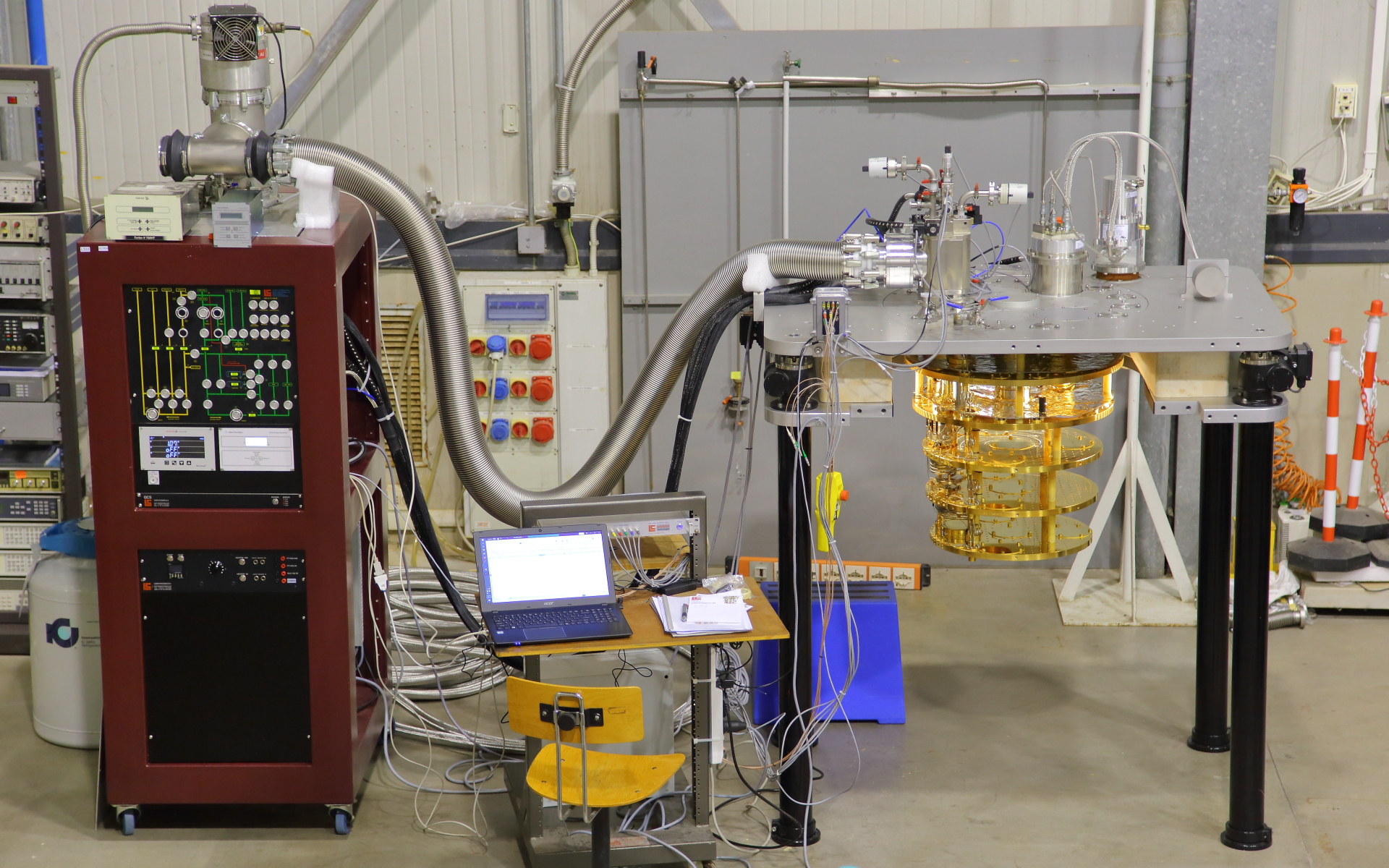
acquired a dilution refrigerator-based cryogen-free cryostat, capable
to cool samples down to 8 mK and with a cooling power of 0.6 mW at
100 mK. The cryostat feature also a fast-insertion tube and has an
experimental space with dimensions d=500 mm and h=500 mm. It can host
a SC magnet to generate a magnetic field of ~10 T. Its delivery is
expected in spring 2019. In
this laboratory are present other cryostats: first, with temperature
control via a cold He flux from liquid helium. There are possible
different set-ups with 300K-4.2K temperature range, is present a NbTi
superconducting magnet with 0-8Tesla DC magnetic field amplitude,
experimental cylinder volume is 600cm3;
second, with manual dipping temperature control in liquid He bath in
the 300K-4.2K range, the experimental cylinder volume is 2400cm3;
third, a portable cryostat in 4.2K liquid He bath with 4 windows, to
radiation test experiments on electron DAFNE-Beam Test Facility (BTF)
line or UV-IR radiation. In particular, there are operative other
cryogenic systems for magnetic characterization and transport
properties to test materials and devices: 1) low frequency
AC multi-harmonic magnetic susceptibility in function of f(Hz),
Hac(Gauss),
Hdc(Tesla),
T(K); 2) AC and DC electrical resistance in function of T(K),
Hdc(Tesla);
3) I-V characteristics versus of T(K), Hdc(Tesla).
The group has experience in simulation of microwave systems in
particular with the ASNYS HFSS code available at LNF.
The
LNL Laboratory of INFN in Padova spans over different activities so
it is well standard equippement as high vacuum pumping systems and
vacuum chambers, two diluition refrigerator units, 5 liquid helium
dewar of different sizes. We cover a large range of EM frequency from
low frequency where we routinely operate a SQUID system up to
Microwave range with cryogenic electronic up to 40 GHz. We have 3
optical tables where we operate 10 laser system in CW mode covering
the frequency from 190 nm up to 1100 nm almost countinously with a
bandwidth of 100 MHz and we have 1 laser operating at fs pulse regime
with a rep. rate of 80 MHz and 2 psec laser operating at GHz rate
with pulses within a psec range. To make systematic study on
radiation matter interaction two electron guns at 100 Kev and
milliamp current are under our control.
The Karlsruhe Institute of Technology
(KIT) is a public research university and one of the largest research
and education institutions in Germany. KIT is one of the leading
universities in the Engineering and Natural Sciences in Europe,
ranking sixth overall in citation impact. As part of the German
Universities Excellence Initiative KIT was accredited with the
excellence status in 2006. In the 2011, performance ranking of
scientific papers, Karlsruhe ranked first in Germany and among the
top ten universities in Europe in engineering and natural sciences.
The KIT partner group have
internationally established expertise in the field of experimental
low-temperature physics. During the last decade, the KIT group led
by Prof. A. Ustinov (PI) have focused on the investigation of
quantum-coherent dynamics of superconducting phase qubits, flux
qubits and transmons. They were first to demonstrate frequency
domain multiplexing readout of superconducting qubits back in 2011 -a
crucial step towards scalable quantum architecture. Another visible
and internationally established expertise of the KIT group is in
coherent manipulation of microscopic two-level defects in
superconducting qubits. More recent work relevant for this proposal
is the first implementation of a quantum metamaterial using 20
superconducting flux qubits.
Prof. Dr. Alexey
Ustinov
(Gender male), a principal investigator for the group, has been in
professor at KIT since 2008. His major field is experimental research
on superconducting quantum circuits. Alexey Ustinov and his group
have an internationally established expertise in the field of
experimental low-temperature physics, nonlinear dynamics of Josephson
junctions and arrays, high-frequency experiments with superconducting
devices, studies of macroscopic quantum effects in these structures,
and superconducting metamaterials. Alexey Ustinov has published over
300 papers in peer reviewed journals receiving over 5000 citations,
and has an h-index of 39. The research of his group has been funded
over the past years by the German Science Foundation (DFG),
Volkswagen Foundation, various funding programs from USA, Russia, and
the EU.
Description
of significant
infrastructure
and
major items
of technical
equipment,
relevant
to
theSUPERGALAX
project
The KIT partner group have
internationally established expertise in the field of experimental
low-temperature physics. During the last decade, the KIT group led
by Prof. A. Ustinov (PI) have focused on the investigation of
quantum-coherent dynamics of superconducting phase qubits, flux
qubits and transmons. They were first to demonstrate frequency
domain multiplexing readout of superconducting qubits back in 2011 -a
crucial step towards scalable quantum architecture. Another visible
and internationally established expertise of the KIT group is in
coherent manipulation of microscopic two-level defects in
superconducting qubits. More recent work relevant for this proposal
is the first implementation of a quantum metamaterial using 20
superconducting flux qubits.
The research team will
have all required infrastructure for the project. For sample
fabrication, we will use state-of-the-art clean room facilities that
are provided by the Nanostructure Service Laboratory (NSL) at KIT.
The NSL provides equipment for the fabrication and characterization
of nanostructures and operates an almost 210 m² clean room of ISO
classes 6 and 7. The large pieces of equipment (EBL, FIB, SEM) are
operated by skilled scientists and technicians who are also
responsible for providing introductory and training courses, for
supporting the users, equipment maintenance and NSL management. For a
sustained operation a usage fee is charged to the users to cover the
project-specific usage costs of clean room (monthly flat charge) and
equipment (hourly rate). At NSL we have full access to 50 kV
professional Jeol e-beam lithography system, multi-target Plassys
evaporation chamber that is ideal for shadow evaporation of qubit
Josephson junctions, wet benches, hot plates, reactive ion etching,
etc. At Physikalisches Institut of KIT, we have available optical
microscopes, bonding machines, resistance probe station to quickly
verify the parameters of custom-fabricated samples, in conjunction
with test measurements down to 300 mK temperature using two He3
cryostats. The group disposes of 4 dilution refrigerators which are
all equipped with GHz-bandwidth signal lines, magnetic shielding and
filters necessary for measurements of superconducting circuits
operated in the coherent quantum regime at millikelvin temperatures.
One of these cryostats (dry BlueFors BF-LD250) will accommodate
measurements for this project. This dilution cryostat is already
equipped with most of electronics to perform the described microwave
domain experiments. Most of the high-frequency devices are readily
available, including a vector network analyzer. The Physikalisches
Institut of KIT maintains a mechanical workshop capable of modifying
the existing and manufacturing new sample holders that we require for
this project. The employed low-noise electronics for timed triggering
of generators and data acquisition devices are custom-designed by the
group together with the electronic workshop of the Physikalisches
Institut. The institute’s helium liquefier station ensures the
constant availability of the cryogenic liquids required to operate
the dilution refrigerators.
The Italy’s National
Metrology Institute
(INRIM)
is the national metrology institute of Italy with the task of
carrying out and promoting scientific research in metrology, new
technologies and materials. INRIM carries out studies and researches
on the realisation of primary standards for the basic and derived
units of the International System of units (SI), assures the
maintenance of such standards, and, in addition, its main R&D
areas are in fundamental physical constants, materials,
nanotechnology and quantum information. Research on nanoscience and
materials is carried out at INRIM from both fundamental and
technological perspectives. Nanoscience explores matter behaviour on
scales of the same order of atomic and molecular sizes (from 1 to 100
nanometres), where the physical properties are totally different from
those on micro- and macroscopic scales, since phenomena are
controlled by quantum physics. Aiming to promote new techniques in
the area of metrology, sensing and imaging, unique measuring methods
are investigated that can go beyond the boundaries of the classical
systems using the specific characteristics of the optical quantum
states, as, in particular, the correlations linked to the state of
entanglement.
Website of the
Italy’s National
Metrology Institute: www.inrim.it
Researches
involved in the SUPERGALAX project
Giorgio
Brida
(Gender Male) is a Senior Researcher at INRiM. He graduated in
Electronic Engineering at the Politecnico di Torino in 1991, and he
received the Ph.D. degree in Metrology, from the Politecnico di
Torino in 1996. Since 1995 he is a staff researcher at IEN Galileo
Ferraris (INRiM from 2006) where he started his activity on classical
radiometry with cryogenic radiometer for the absolute spectral
responsivity calibration of photodetectors. His main field of
activity is the design of Silicon photodiodes with predictable
spectral responsivity, the characterization of single photon
detectors (SPAD, TES, SSPD e CCD) and single photon sources (SPS),
parametric down-conversion in non-linear crystals and color center in
diamonds. He is responsible for maintaining and disseminating the
optical primary standard scale of radiant power and spectral
responsivity. His current research interests includes the
metrological traceability from classical radiometry to SPS, quantum
enhanced measurement techniques and characterization of novel
nanophotonic devices. Since 2007 he contributed as Work-Package
Leader to the several European Metrology Research Project (EMRP):
qu-Candela,
Newstar,
SIQUTE,
MIQC,
MIQC2
and PhotoLED.
Alice Meda
(Gender Female) is a Research at INRiM. She graduated in Physics at
the Università degli Studi di Torino in 2003; she received the Ph.D.
degree in
Metrology, from the Politecnico di Torino in 2007. Her
most recent works regard, on the one side, the realization of
protocols in which one of two correlated beams (twin beams or thermal
light) is addressed to a target (a beam splitter or a faint object)
and the other will be used as an ancilla. She applied the idea to
different protocols: Sub Shot Noise quantum imaging, Ghost Imaging
and dynamics of Gaussian states. On the other side, her research
activity is devoted to the realization of a QKD Italian backbone for
the realization of a point-to-point QKD link between Torino and
Firenze and to the analysis of side channel attacks in QKD protocols.
Until March 2015,
she was the principal investigator of the Torino Research Unit for
the Italian three year project “FIRB 2010 -Futuro in Ricerca”
Light correlations for high precision innovative sensing (LICHIS) for
the design and development of innovative, high precision measurement
schemes based on the correlations (classical and entanglement)
existing between two or more beams of light. She has provided
important contribution to European projects (QuCandela, BRISQ2,
SIQUTE, MIQC, MIQC2) for quantum metrology, quantum communication and
quantum information technologies.
Emanuele Enrico
(Gender Male) is a Researcher at INRiM. He graduated in Physics of
Advanced Technologies in 2008 (Università degli Studi di Torino). In
2012 he obtained a Ph.D. in Metrology (Politecnico di Torino). From
2010 to 2016 he has been Technical Assistant for the Research
Institutions at the Italian National Institute of Metrological
Research (INRiM). In the former institution he has was responsible
for the realization of quantum devices based on nanostructured thin
film technologies with applications in sensors, quantum metrology and
the nano-photonics.
He has been guest researcher at the
National Enterprise for Nanoscience and Nanotechnology (NEST) of the
Scuola Normale Superiore, Pisa Italy, where he developed a reference
sample device for the generation of quantized electric current. To
date he is the author of 56 articles published in international
journals. E.E. has been invited speaker at numerous national and
international conferences,
he is referee for international journals, and has been tutors of many
under graduated and PhD students.
Since 2011, E.E. participates in 15
European and national projects as an expert partner in
nanofabrication for thin film devices and life science. He has been
workpackage leader of the “Fabrication” WP in the EMRP 2012
Microphoton project and “Impact” WP in EMPIR 2017 ParaWave. He
has been PI for 3 beamline projects at the ESRF (Grenoble) and for 1
NanoSIMS (Open University, UK) project in the framework of the
Europlanet 2020.
Dr. Mauro Rajteri
(Gender Male) is an Electronic Engineer (Politecnico di Torino, 1990)
with a PhD in Physics (Politecnico di Torino, 1996). From 1999 he is
a researcher at INRIM. His main fields of research are
superconducting materials and devices in particular as light
detectors from UV to IR. He is responsible of the laboratory on
“Innovative cryogenic devices”. During his activity, he developed
skills on measurement of superconducting materials and devices at
cryogenic temperatures. In the last years the research has been
focalized on the development of transition-edge sensors (TESs),
microcalorimeters with photon-number resolving capability operated in
a 3 He/ 4 He dilution refrigerator and in an Adiabatic
Demagnetization Refrigerator. He carried out activity on the optical
characterization of materials (by spectrophotometry and ellipsometry)
and antireflection coatings. He has been involved in research
projects for the Italian Space Agency ASI on superconductive
photodetectors and in many research project within the EC 7th
programme ERANET-plus and EMPR. He has been the coordinator of the
Piedmont Region research project E45 “Superconducting
transition-edge sensors for single photon counting” (2006-2009),
and “Evaluation of photon statistics with photon number resolving
detectors and correlated photon pair sources” Joint Projects for
the exchange of researchers within the Executive Programme
Italy-Japan 2009-2012). He has been responsible of the workpackage
“Optimised novel materials for high performance NEMS”, for the
European project EMRP-NEW08 “Metrology with/for NEMS (MetNEMS)”
(2012-2015).
He is the author of
more than 70 papers on international peer reviewed journals, he is
referee for international journals,
and has been tutors of
many under graduated and PhD students.
Description
of significant
infrastructure
and
major items
of technical
equipment
of the INRIM, relevant
to
theSUPERGALAX
project
The research team has
a long time experience in fabrication of thin film devices based on
NV color centers, Coulombic devices, Josephson junctions and
superconducting nanonwires. The research team has all necessary
technological equipment for a full cycle device fabrication starting
from photo mask realization up to final assembling of chips on chip
carrier:
Clean room facilities;
Variable-pressure Electron Beam
Lithography in a modified SEM-FIB – FEI Quanta3D FEG (beam up to 30
kV)
Laser writer system
for laser beam photolithography Heidlberg uPG-101;
Chemical hoods and storages for resist
preparation and development (spinner, hot-plate)
Chemical hood for lift-off processes
(ultrasonic bath)
Multi-pocket (6x,4cc) high vacuum
electron beam evaporator for high quality ultra-thin film (4->250
nm) deposition (normal metals and superconductors). Load-lock
equipped with ion milling system (Ar, O2 – Telemark XIAD 1kV) for
substrate cleaning and controlled gas inlet for tunnel junctions’
realization. Tiltable sample holder.
Ultra high vacuum
dc-magnetron multi target (Nb, Al) deposition system equipped with
load-look chamber.
Vacuum deposition
system for thermal evaporation of metallic (Cr, Au) thin films;
Plasma Enhanced Chemical Vapour
Deposition (PECVD) for the growth of SiO2
dielectric films
Reactive Ion Etching with Ar, CF4,
O2
gases
Plasma Matrix (bDiscom) cleaner, N2,
Ar and O2
gases for resist descum and substrate cleaning
Wedge bonder, Al wire. Bump bonding and
ball bonding (Au) capabilities.
Wafer dicing: diamond scriber
Alpha Step Profilometer for thickness
step-height evaluation
Ellipsometer for dielectric thickness
evaluation
Optical microscope
The group has an
experience in experiments at ultra-low temperatures. The group is
equipped by